


















 InvisBrace
Digital lingual orthodontic appliances achieve ABO finishing quality comparable to labial orthodontic appliances
A retrospective study of 200 adults found that digitally planned straight-wire lingual orthodontic appliances achieved occlusal finishing quality comparable to labial orthodontic appliances according to the ABO grading system, although the average treatment time was longer.
Why should finishing quality be assessed objectively?
Mắc cài mặt lưỡi đáp ứng nhu cầu thẩm mỹ vì toàn bộ khí cụ nằm ở phía trong răng. Tuy nhiên, vị trí làm việc khó quan sát, khoảng thao tác hẹp và yêu cầu kiểm soát dây cung tinh tế khiến kỹ thuật này thường bị xem là phức tạp hơn mắc cài mặt ngoài. Quy trình kỹ thuật số hiện đại – gồm setup ảo, đặt mắc cài trên mô hình số, in mẫu và chuyển gián tiếp – giúp đơn giản hóa nhiều bước, nhưng hiệu quả sau cùng vẫn cần được đo bằng các chỉ số độc lập thay vì chỉ dựa trên quan sát lâm sàng.
The study used two tools developed by the American Board of Orthodontics (ABO). The Discrepancy Index (DI) describes pretreatment complexity; the Objective Grading System (OGS) evaluates finishing quality from dental casts and panoramic radiographs, including alignment, marginal ridges, buccolingual inclination, occlusal contacts, occlusal relationships, overjet, interproximal contacts, and root angulation. A lower OGS score indicates a result closer to the ideal standard.
Study design and treatment protocols
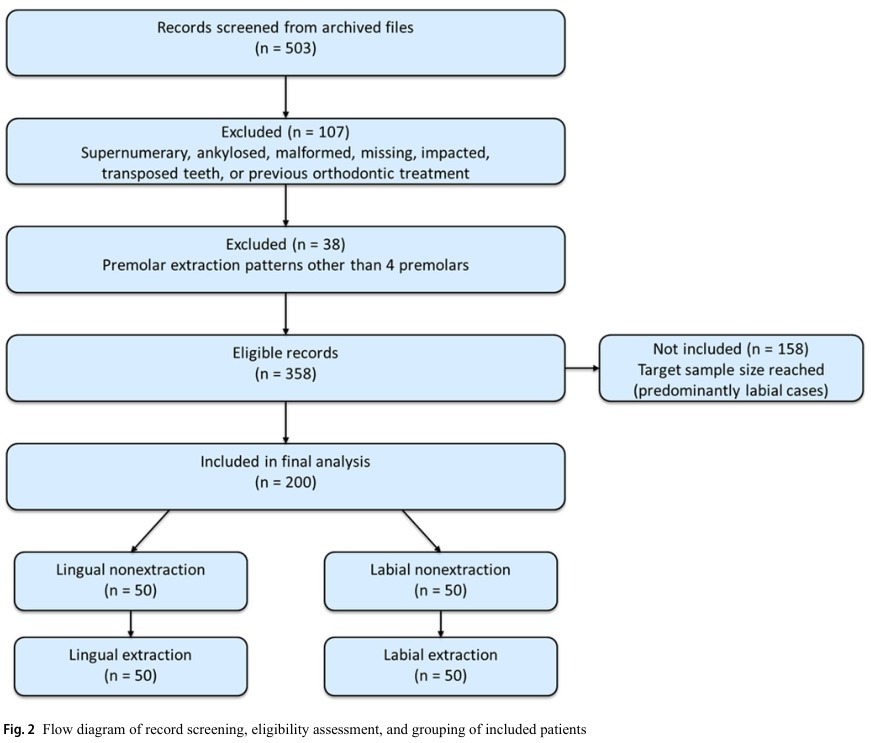
Nhóm tác giả phân tích 200 bệnh nhân từ 18 đến 35 tuổi, chia đều thành bốn nhóm, mỗi nhóm 50 người: mặt lưỡi không nhổ răng, mặt lưỡi nhổ răng, mặt ngoài không nhổ răng và mặt ngoài nhổ răng. Tất cả đã hoàn tất điều trị hai hàm, có đủ hồ sơ trước và sau điều trị và không có những bất thường răng – mặt có thể làm sai lệch việc chấm điểm.
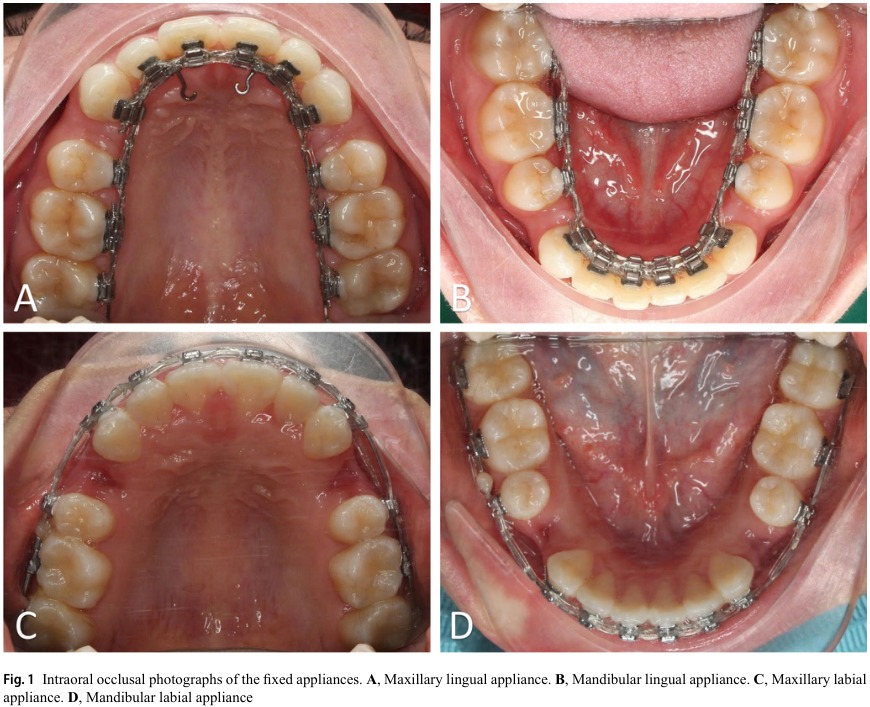
In the lingual groups, the setup and bracket positions were planned with digital lingual orthodontic software. The bracketed model was 3D printed, and double vacuum-formed trays were used to transfer the brackets intraorally. A 0.018 × 0.025-inch straight-wire system was used with a sequence of nickel-titanium wires followed by stainless steel wires for space closure and finishing. The labial groups used 0.022 × 0.028-inch self-ligating brackets with corresponding archwires.
Extraction cases were limited to the removal of four first or second premolars. Anchorage, intermaxillary elastics, and miniscrews were selected according to individual treatment objectives. Two calibrated orthodontists, blinded to treatment group, scored the DI and OGS. Intraexaminer and interexaminer reliability was high, with intraclass correlation coefficients above 0.90 for total DI and OGS scores.
Comparable finishing quality with both appliance systems
Pretreatment complexity was reasonably comparable. Median DI scores ranged from 17 to 22 points across the four groups and did not differ significantly (p = 0.149), providing a stronger basis for comparing the posttreatment results.
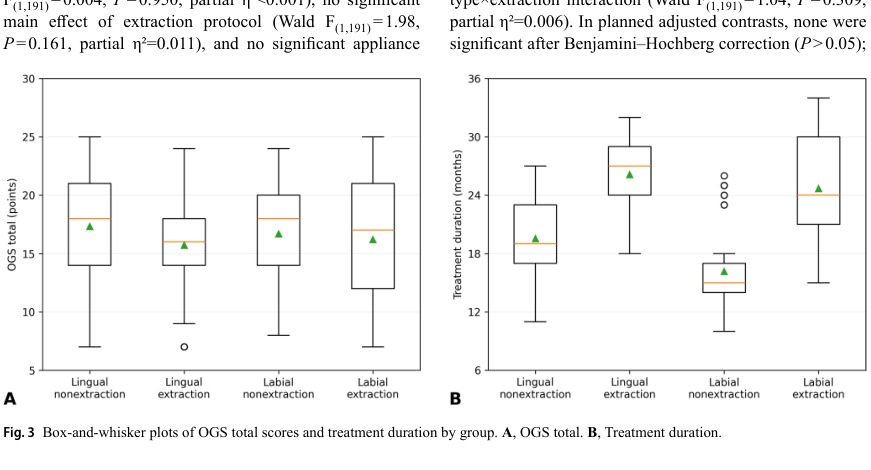
Điểm OGS trung bình chưa hiệu chỉnh lần lượt là 17,3; 15,7; 16,7 và 16,2 điểm. Tất cả 200 ca đều có tổng điểm OGS không quá 25, nằm trong ngưỡng hoàn tất của đánh giá mẫu hàm – phim X-quang ABO. Sau hiệu chỉnh theo DI ban đầu, tuổi, giới và phân loại Angle, không có ảnh hưởng có ý nghĩa của loại mắc cài, phác đồ nhổ răng hay tương tác giữa hai yếu tố đối với tổng điểm OGS.
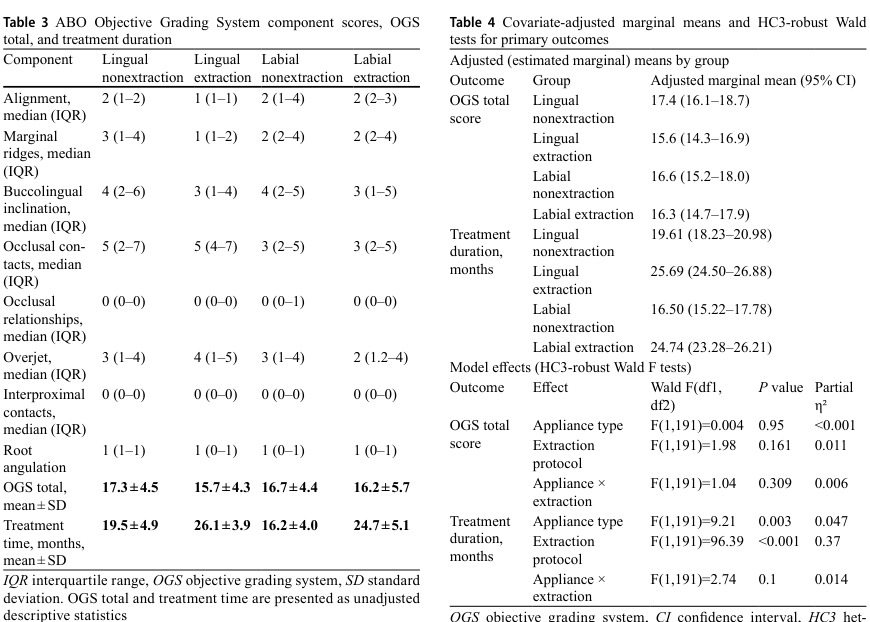
Estimated adjusted OGS values were 17.4 points for lingual nonextraction, 15.6 for lingual extraction, 16.6 for labial nonextraction, and 16.3 for labial extraction. The appliance-type effect was virtually zero (p = 0.950), while the effect of extraction on OGS was also nonsignificant (p = 0.161).
The trade-off was a longer treatment time
Thời gian điều trị hiệu chỉnh trung bình là 19,61 tháng ở nhóm mặt lưỡi không nhổ răng, 25,69 tháng ở nhóm mặt lưỡi nhổ răng, 16,50 tháng ở nhóm mặt ngoài không nhổ răng và 24,74 tháng ở nhóm mặt ngoài nhổ răng. Nhìn chung, điều trị mặt lưỡi dài hơn mặt ngoài khoảng 2,0 tháng; khác biệt có ý nghĩa thống kê (p = 0,003). Điều trị nhổ răng dài hơn không nhổ răng khoảng 7,2 tháng (p < 0,001).
The additional time may reflect the technique sensitivity of lingual procedures, restricted access, archwire adjustment time, and the number of refinements needed during finishing. In extraction cases, space closure, anchorage control, and root paralleling also reasonably prolong treatment.
Clinical implications
The findings indicate that patients who prioritize esthetics may select digitally planned lingual orthodontic appliances without accepting inferior occlusal finishing. However, counseling should include the possibility of a longer treatment course, particularly in extraction cases requiring complex space closure and root control.
The study does not prove that every lingual system performs identically. Success still depends on the setup, bracket-transfer accuracy, clinician experience, biomechanical choices, and the desired finishing standard. The OGS also measures cast and panoramic-radiographic results and does not directly capture speech, tongue discomfort, oral hygiene, or patient satisfaction.
Limitations and conclusion
This retrospective single-center study did not randomize appliance selection, which was largely driven by patient esthetic preference. Baseline characteristics were not fully balanced, and appointment intervals, compliance, bracket breakage, and the clinician's debonding threshold may have caused residual confounding.
Within the study limits, digitally planned straight-wire lingual orthodontic treatment achieved ABO-OGS finishing quality comparable to labial fixed orthodontic appliances in adults. The esthetic benefit did not reduce occlusal quality, but lingual orthodontic treatment generally required more time; extraction protocols also substantially prolonged treatment.
Source: Nguyen VA, Nguyen TT, Vo TNN, Tong MS, Nguyen TA. “Clinical outcomes of digital straightwire lingual versus labial fixed appliances assessed with American Board of Orthodontics indices: a retrospective cohort study.” Clinical Oral Investigations. 2026;30:108. DOI: 10.1007/s00784-026-06804-z. This article was translated, edited, and condensed to approximately 30% of the principal content; images were extracted from the original publication.