

















 InvisBrace
Accuracy of customized lingual orthodontic brackets: direct metal 3D printing compared with casting
A laboratory study of 36 customized lingual orthodontic brackets found that both direct metal 3D printing and casting achieved clinically acceptable positional accuracy. Printed brackets initially showed greater dimensional error and friction, but both improved substantially after polishing.
Two fabrication routes for customized brackets
Customized lingual orthodontic brackets must adapt closely to the tooth surface, reproduce the planned position, and provide a sufficiently accurate slot for torque expression. Two common fabrication routes are direct metal printing by selective laser melting (SLM), and printing a wax pattern followed by lost-wax casting. Metal printing offers automation, material efficiency, and complex geometry, but its layer-based surface may be rougher and may increase archwire friction.
This study evaluated more than global shape deviation. The investigators simultaneously measured fitting-surface trueness, the actual bracket base-tooth gap, linear and angular positional error, slot height, slot-wall convergence, and the frictional force produced as an archwire slid through the slot.
Experimental design
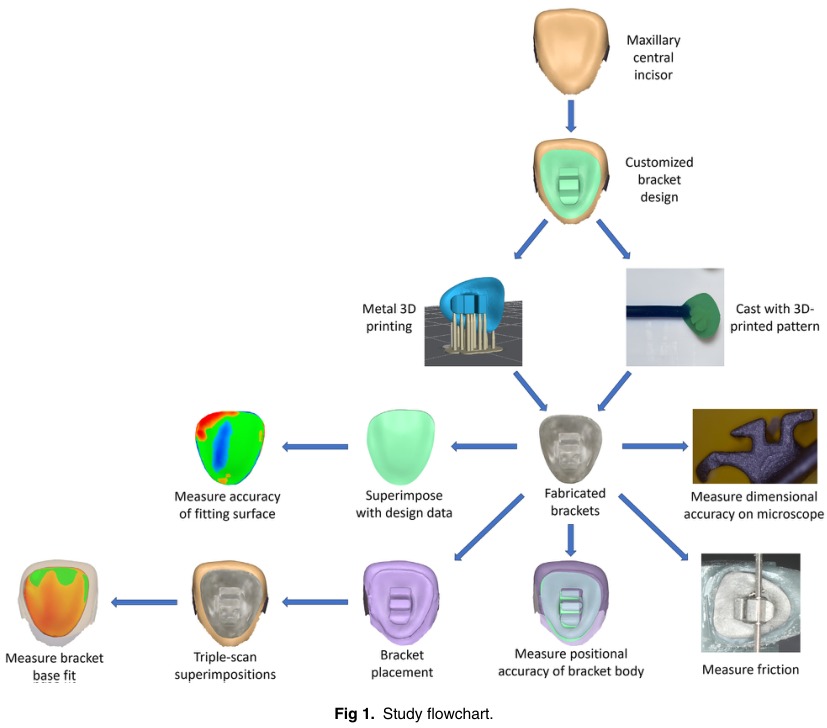
A metal maxillary central incisor was scanned, and a double-slotted customized lingual bracket was created with 3D design software. The bracket base was 0.3 mm thick with a 0.03-mm offset from the tooth surface; the slot for a 0.018-inch archwire was designed at a height of 0.480 mm to allow for manufacturing tolerance.
Thirty-six brackets were fabricated: 18 were printed directly in cobalt-chromium alloy and 18 were cast in cobalt-chromium from 3D-printed wax patterns. Both processes used a 90° build orientation and a 30-µm layer thickness. After fabrication, the brackets were sandblasted and supports were removed, but no polishing was performed before the initial scans.
Độ đúng của mặt đáy được tính từ sai lệch RMS giữa sản phẩm và thiết kế. Khe thực tế được đo bằng phương pháp triple-scan: quét riêng mắc cài, quét tổ hợp răng – mắc cài sau khi đặt, rồi chồng dữ liệu để tính khoảng cách toàn bề mặt. Vị trí thân mắc cài được đánh giá bằng sai lệch tuyến tính và góc so với vị trí dự kiến.
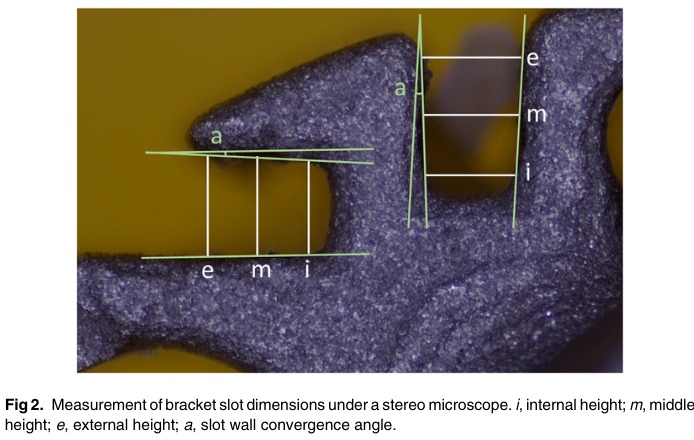
Slot height was measured at 12 points per bracket under a stereo microscope. Friction was measured by pulling a 0.017 × 0.025-inch stainless steel wire through the slot for 5 mm at 0.5 mm/min. All samples then underwent three hours of mechanical polishing and 2,000 thermocycles between 5°C and 55°C before dimensional and friction measurements were repeated.
Base fit and positional results
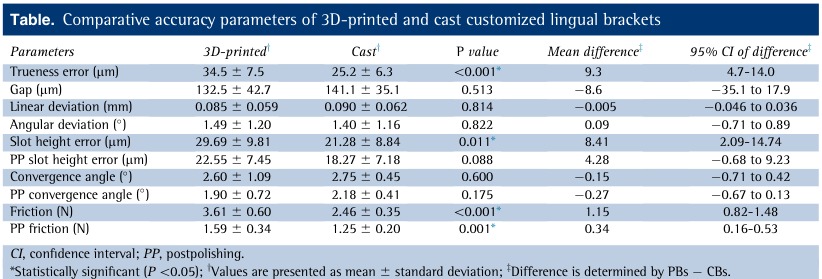
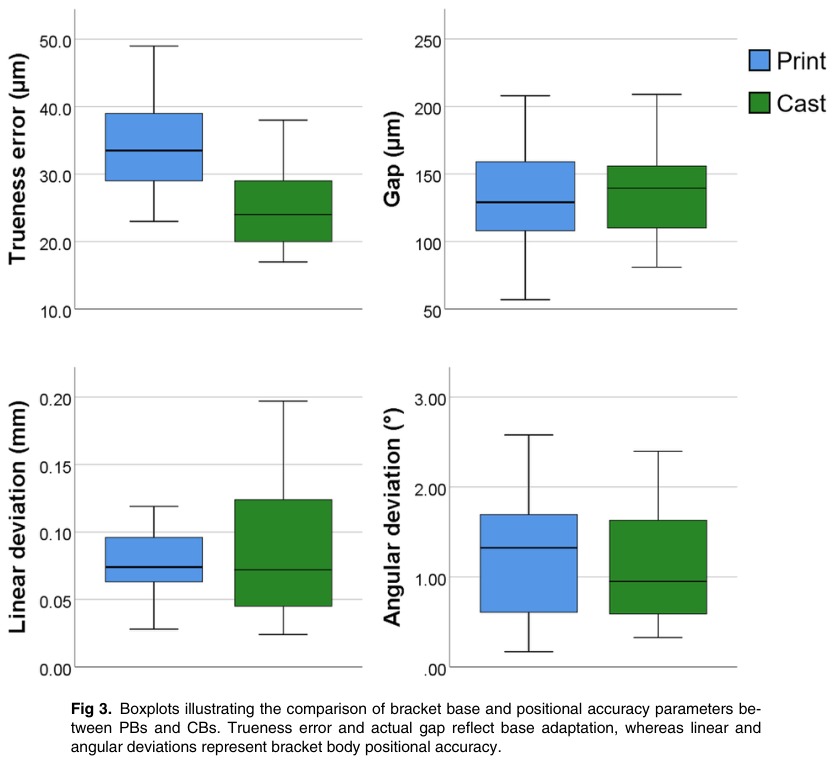
Sai số độ đúng mặt đáy của nhóm in là 34,5 ± 7,5 µm, cao hơn nhóm đúc 25,2 ± 6,3 µm (p < 0,001). Tuy vậy, khe thực tế giữa đáy mắc cài và răng không khác biệt có ý nghĩa: 132,5 µm ở nhóm in và 141,1 µm ở nhóm đúc (p = 0,513).
Linear positional deviations were very small at 0.085 mm and 0.090 mm, while angular deviations were 1.49° and 1.40°, respectively. Neither difference was significant. These measurements were within the 0.5-mm and 2° limits commonly regarded as clinically acceptable, indicating that both fabrication methods reproduced bracket body position well.
Polishing improved slot dimensions and friction
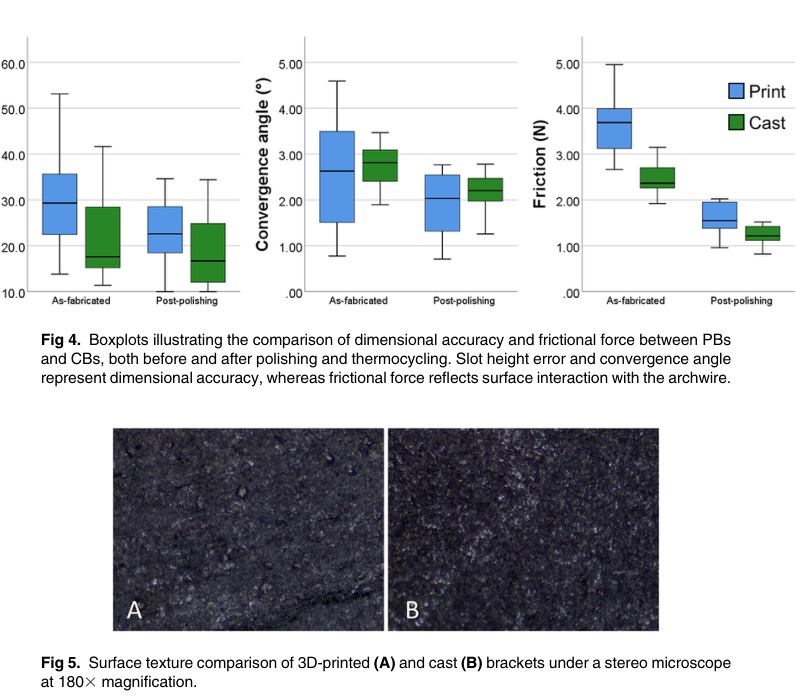
Before polishing, slot-height error was 29.69 ± 9.81 µm in the printed group and 21.28 ± 8.84 µm in the cast group (p = 0.011). After polishing and thermocycling, error decreased to 22.55 µm and 18.27 µm; the difference was no longer statistically significant (p = 0.088). Slot-wall convergence was similar between fabrication methods both before and after processing.
Lực ma sát ban đầu của mắc cài in đạt 3,61 ± 0,60 N, so với 2,46 ± 0,35 N của mắc cài đúc (p < 0,001). Sau đánh bóng và lão hóa nhiệt, lực ma sát giảm mạnh xuống 1,59 N và 1,25 N. Nhóm in vẫn có ma sát cao hơn (p = 0,001), nhưng chênh lệch đã thu hẹp đáng kể.
Implications for design and manufacturing
The results support direct metal 3D printing as a viable route for customized lingual orthodontic brackets, especially when direct production from digital data is preferred and wax-pattern distortion is to be avoided. However, a newly printed part should not be considered a finished clinical product. Layer lines and incompletely fused particles can roughen the slot, increase friction, and compromise sliding mechanics.
Build orientation, layer thickness, slot compensation, support removal, and polishing protocols therefore require careful control. On smaller teeth with less distinct anatomy, such as mandibular incisors, an indirect bonding tray remains important for accurate placement even when the bracket itself is manufactured precisely.
Limitations and conclusion
This in vitro study used only one maxillary central-incisor design and one printer for each fabrication route. Saliva, patient movement, long-term mechanical stress, and bond strength were not fully reproduced. The findings therefore do not represent every alloy, printer, or postprocessing protocol.
Both direct metal 3D printing and casting from a printed wax pattern produced customized lingual orthodontic brackets with clinically acceptable positional accuracy. Directly printed brackets showed greater initial base error, slot-height error, and friction, but polishing provided substantial improvement. Optimized postprocessing is essential for translating the manufacturing advantages of digital production into efficient clinical mechanics.
Source: Nguyen VA, Trinh KL, Le TLA, Nguyen HC, Nguyen TT. “Comparative evaluation of the accuracy of customized lingual orthodontic brackets fabricated by metal 3-dimensional printing and casting: An in vitro study.” American Journal of Orthodontics and Dentofacial Orthopedics. 2025;168:542-550. DOI: 10.1016/j.ajodo.2025.05.002. This article was translated, edited, and condensed to approximately 30% of the principal content; images were extracted from the original publication.