


















 InvisBrace
Comparison of incisor tilt control with lingual and buccal braces in treatment without tooth extraction
A retrospective study of 95 adults treated without tooth extraction with mini-implant anchorage showed that lingual braces controlled lower incisor inclination better than buccal braces, while upper incisor inclination and mandibular plane angle were almost equivalent.
Why is it necessary to compare two braces systems?
In orthodontic treatment, adults do not extract teeth, create space by dilating, grinding or moving them away, which often comes with the risk of causing the front teeth to lean forward. Bone anchorage with mini-implants helps control reaction forces, but the force location and biomechanics of lingual braces are clearly different from buccal braces. Therefore, the important question is whether the two systems make a meaningful difference in incisal inclination and verticality.

Research design
The authors analyzed records of 95 patients aged 18 years and older, including 47 cases of lingual braces and 48 cases of buccal braces. All were treated without tooth extraction, had enough tilted skull films before and after treatment, and had no dento-facial deformities, impacted teeth, displaced teeth or orthodontic history.
The lingual group uses 0.018 × 0.025 inch straight wire brackets. The setup is designed using a digital lingual orthodontic software, then the model is 3D printed and the braces are transferred indirectly using a two-layer laminate tray. The outer group uses 0.022 × 0.028 inch self-ligating brackets and is directly attached. Both groups used mini-implants to support anchorage; Placement and mechanics are selected according to each case's goals.
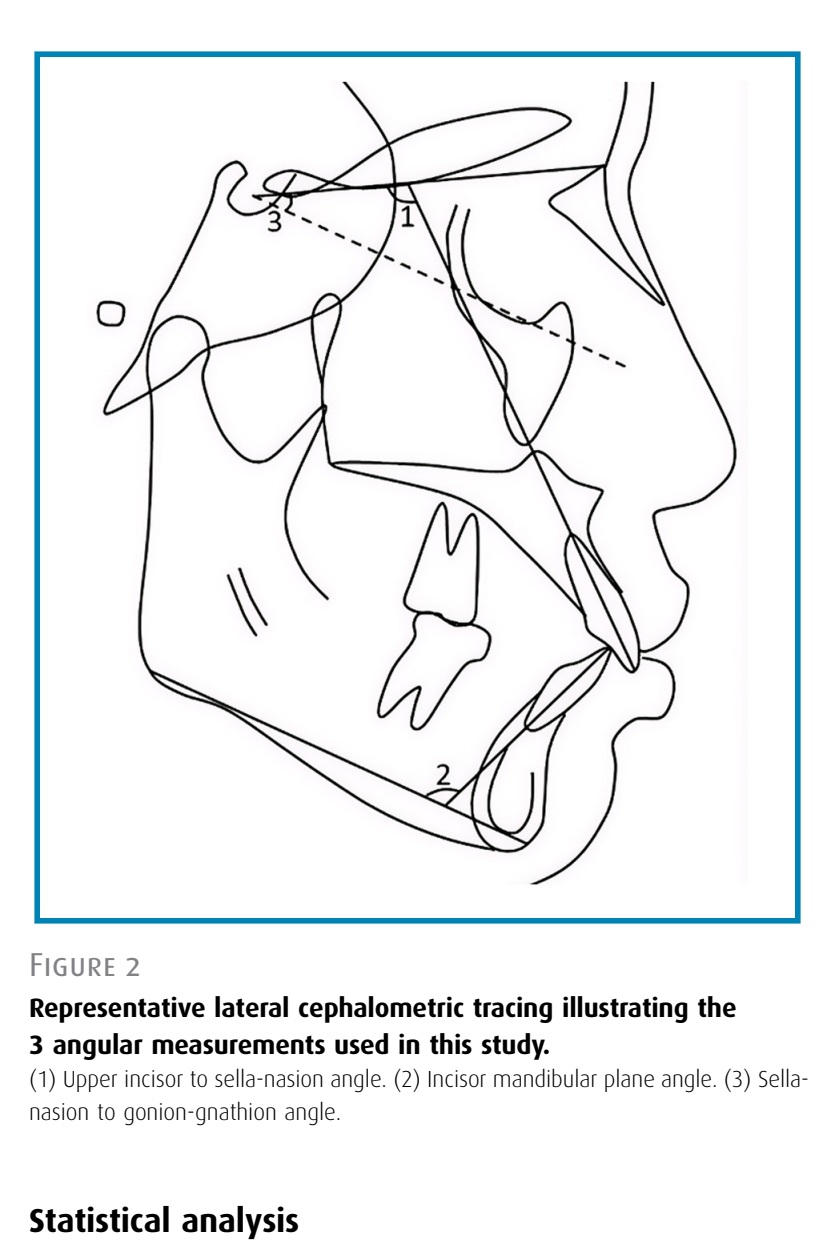
Post-treatment outcome variables included U1-SN, IMPA and SN-GoGn. ANCOVA analysis adjusted for baseline value, crowding level, age, and relevant treatment variables. This is a more appropriate comparison than just looking at the raw change between the two groups.

Main results
After adjustment in the main model, the IMPA of the buccal bracket group was 2.49° higher than the lingual bracket group, with a 95% confidence interval from 0.77° to 4.21° and p = 0.005. This shows that the lower front teeth tend to protrude more when using external braces in this group of patients.
In contrast, the U1-SN difference between the two groups was only 1.61° and not statistically significant (p = 0.115). The SN-GoGn angle was almost no different, with a difference of −0.01° (p = 0.977). Thus, the most prominent difference lies in the control of the lower incisors, not the upper incisors or bone verticality.
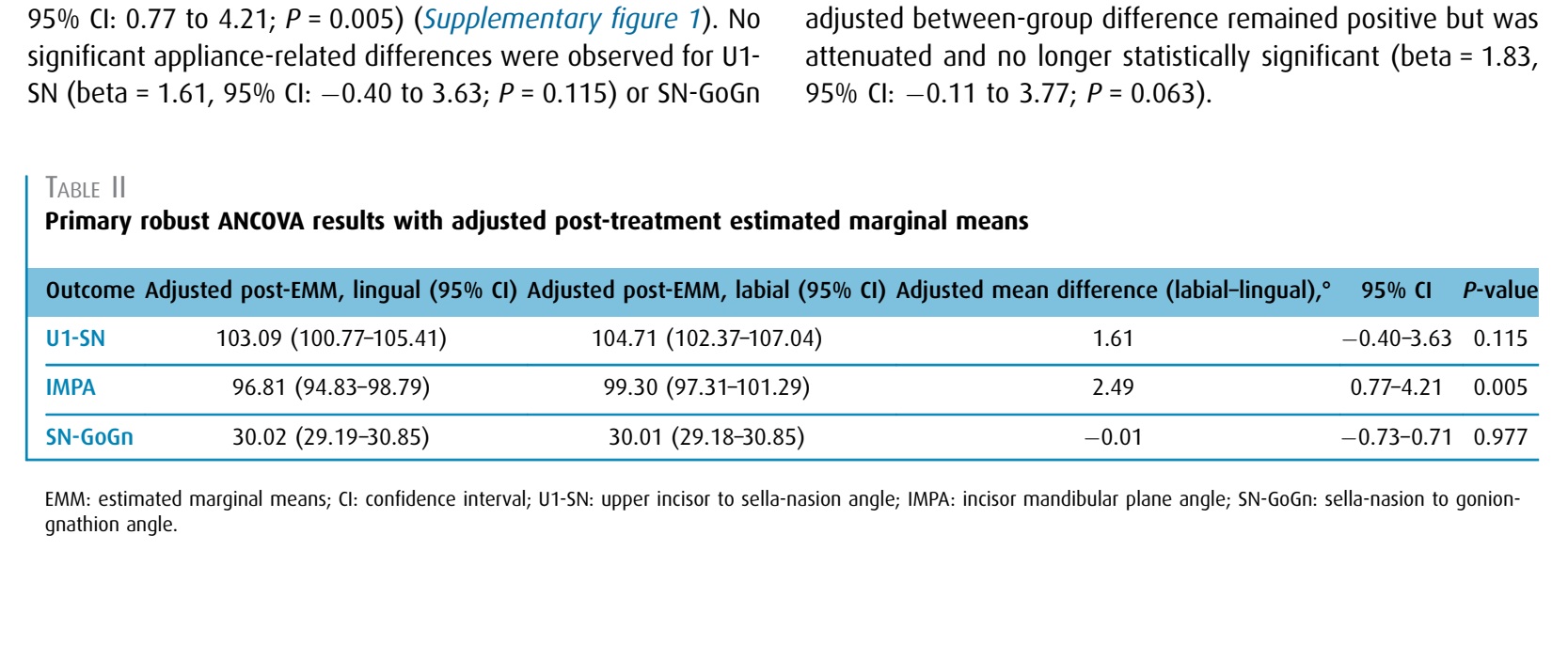
In the more fully adjusted model, the IMPA difference decreased to 1.83° and p = 0.063. Although no longer reaching the threshold for statistical significance, the direction of effect remained consistent in sensitivity analyses. The initial level of crowding is also related to IMPA after treatment: the more crowding, the more the tendency for the lower incisors to lean forward increases.
Clinical implications
The results suggest that the choice of bracket system may affect the ability to control lower incisors in non-extraction treatment with bone anchorage. For patients with thin periodontal tissue, protruding lower incisors, or narrow alveolar bone boundaries, the torque control advantage of lingual braces may be worth considering.
However, an average difference of about 2° is moderate and must be interpreted in the context of each case. Torque control still depends on setup, precision of bracket placement, arch wire sequence, mini-implant position, arc shape and degree of mechanical compliance.
Limitations and conclusion
This was a retrospective, nonrandomized, single-center study. The two groups differed in some initial characteristics, slot size, bracket attachment method and anchorage position; Therefore, the entire difference cannot be attributed to the bracket placement surface. Two-dimensional cranial tilt films also do not fully depict three-dimensional changes.
Within the limits of the study, lingual and buccal braces gave similar results in terms of upper incisor inclination and mandibular plane angle. Lingual braces are associated with lower lower incisor protrusion, but the clinical significance needs to be assessed according to each patient's goals and biological limitations.
Source: Nguyen VA, Pham TNA, Nguyen HC, Dang TN, Nguyen TT. “Comparative post-treatment incisor inclination and mandibular plane angle in adults treated with lingual and labial fixed appliances under miniscrew-supported nonextraction mechanics: A retrospective study.” International Orthodontics. 2026;24:101183. DOI: 10.1016/j.ortho.2026.101183. This article was translated, edited, and condensed to approximately 30% of the principal content; images were extracted from the original publication.